
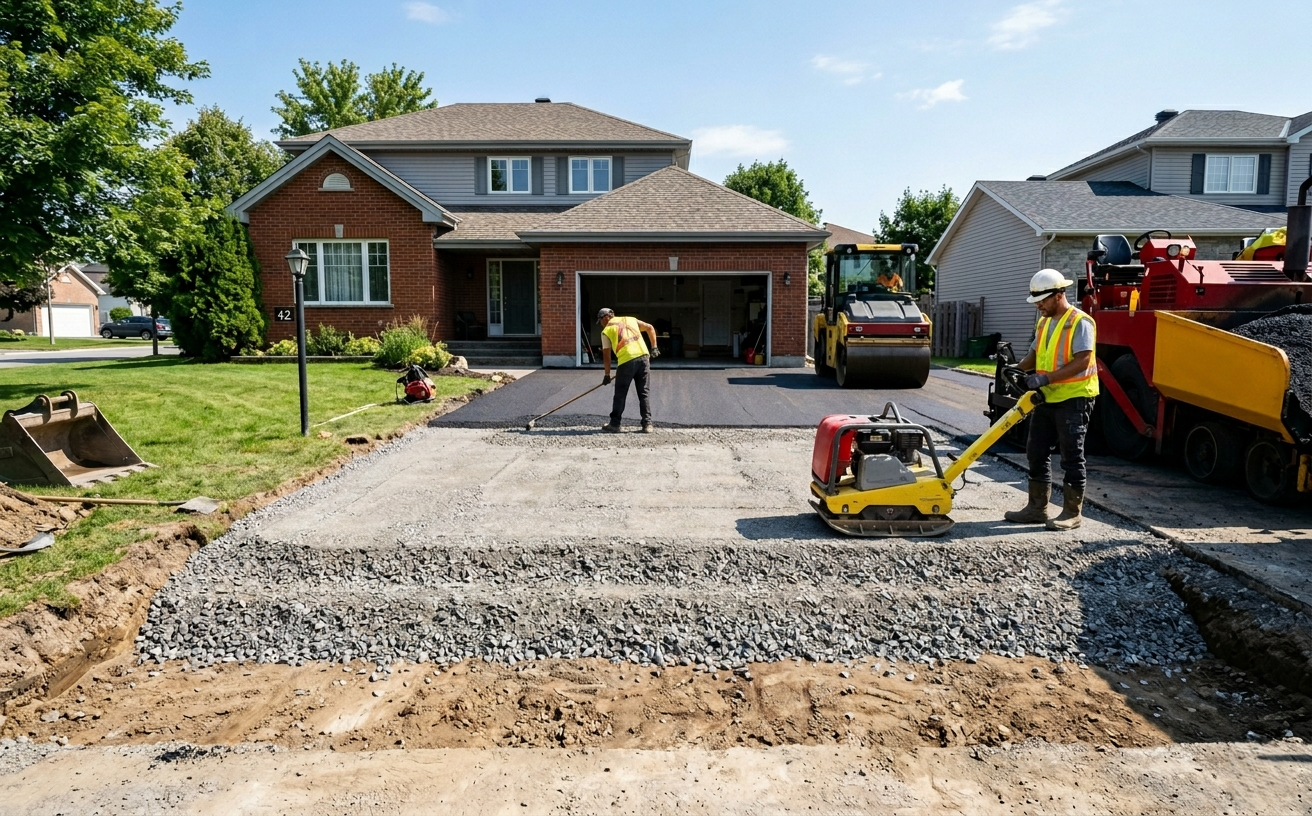
When most homeowners picture a new driveway, they picture the smooth black surface. It’s what you see, what you park on, and what the neighbours notice. But ask any experienced paving crew what actually determines whether a driveway lasts five years or twenty-five, and they’ll point straight down, past the asphalt, to the base underneath. The surface gets the attention. The base does the work.
What “the Base” Actually Means
The base is the layer of compacted gravel and aggregate that sits between the bare ground and the asphalt you drive on. It’s the foundation of the entire driveway. The asphalt on top is really just a flexible, weather-resistant skin. Without a properly built base beneath it, even the best asphalt will fail, and usually sooner than you’d expect.
A good base does three jobs at once:
Spreads the Load
Your vehicles don’t actually rest on the asphalt. The weight passes through it and into the base, which distributes that load across the ground below. A thin or poorly compacted base lets weight concentrate in spots, and that’s where cracks and sinking start.
Manages Water
Water is the number one enemy of any driveway in our climate. A correctly built base lets water drain away instead of pooling and freezing underneath. This drainage function is exactly why base depth and grading get so much attention during a quality install.
Resists Frost Movement
In Ottawa, the ground freezes, swells, and thaws repeatedly all winter. A deep, well-compacted base absorbs and resists that movement. A weak base shifts with every freeze-thaw cycle, and the surface cracks to match.
Why the Base Is Where Cheap Jobs Cut Corners
Here’s the uncomfortable truth: the base is invisible once the job is done. Nobody driving by can tell whether the crew dug deep enough, used the right material, or compacted it properly. That’s exactly why it’s the first place a rushed or low-bid operation cuts corners.
A contractor can save real money by digging shallow, skipping proper compaction, or laying asphalt over soft or organic ground. The driveway looks perfect on day one. The problem shows up two or three winters later, long after the cheque has cleared. By then you’re not looking at maintenance, you’re looking at a rebuild.
This is one of the biggest reasons our driveway paving ottawa work starts with assessing site conditions before a single load of asphalt is ordered. The base requirements for a sandy lot and a clay-heavy lot are completely different, and getting that wrong undermines everything above it.
How a Proper Base Gets Built
A driveway built to last follows a sequence, and every step matters:
Excavation
The existing ground is dug out to the right depth. How deep depends on the soil and how the driveway will be used. A residential car driveway and a surface meant for heavier vehicles need different excavation.
Removing Soft Material
Organic soil, clay pockets, and soft spots are removed. Asphalt laid over unstable ground has nothing solid to rest on, no matter how thick the surface layer is.
Adding and Compacting the Base
Gravel and aggregate are added in layers and compacted properly. Compaction is not optional. Loose base material settles unevenly over time, and uneven settling is what produces dips and cracks.
Grading for Drainage
The whole surface is shaped so water runs off and away from the driveway and your home, rather than pooling or draining toward the foundation. Good grading is the difference between a driveway that sheds water and one that traps it.
This is the same disciplined approach we bring to every residential paving ottawa project, because the steps you can’t see are the ones that decide how long the driveway lasts.
What This Means When You’re Getting Quotes
Understanding the base changes how you read a quote. When two estimates come in far apart, the gap is very often in the part you can’t see. The cheaper one may be planning less excavation, a thinner base, or less compaction.
A few questions worth asking any contractor:
Ask About Depth
How deep will they excavate, and what base depth are they planning for your specific soil?
Ask About Compaction
How will the base be compacted, and in how many layers?
Ask About Drainage
How will the driveway be graded, and where will water go?
A contractor who answers these clearly is one who builds from the ground up. The same standards apply whether it’s a single home driveway or a large commercial asphalt paving project, since both live or die on what’s underneath.
The Bottom Line
A beautiful surface on a poor base is a problem waiting to happen. A solid base under any surface is a driveway that lasts. When you’re investing in one of the most-used parts of your property, the smartest thing you can do is pay attention to the part you’ll never see again once it’s finished.
Are you ready to get your project started? Contact us for a free quote and a driveway built properly from the base up.
