
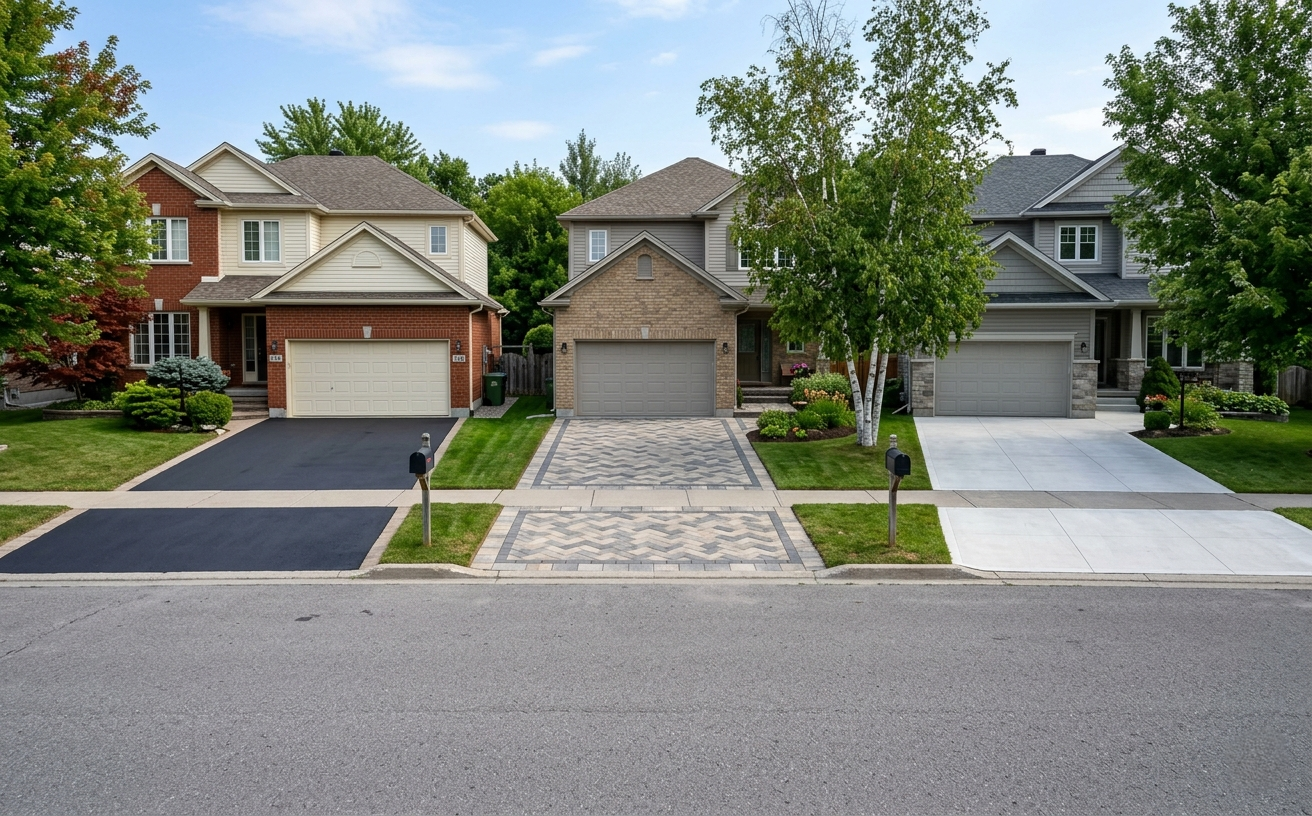
A new driveway is a long-term investment, and the material you choose shapes how it looks, how much it costs, and how it holds up to decades of Ottawa winters. Asphalt, interlock, and concrete each have a genuine case to make. The right one depends on your budget, your style, and how much maintenance you’re willing to take on. Here’s an honest comparison to help you decide.
First, the One Thing They All Share
Before comparing materials, it’s worth saying that all three live or die on what’s underneath them. A premium surface on a poorly prepared base will fail early, while a well-built base makes any of these three perform for decades. Keep that in mind as you read, because the material is only half the decision.
Asphalt: The Practical Workhorse
Asphalt remains the most popular driveway choice in the region, and for good reason. It’s the most affordable option upfront, installs quickly, and its flexibility is a real advantage in our climate, since it shifts slightly with freeze-thaw movement instead of cracking rigidly.
The Strengths
- Lowest upfront cost of the three
- Fast to install and ready to use quickly
- Flexes with freeze-thaw movement rather than cracking
- Can last up to 25 years when properly maintained
The Trade-Offs
Asphalt offers limited design options beyond a clean black finish, and it benefits from periodic maintenance to reach its full lifespan. For most homeowners weighing paving and driveways options, it’s the dependable default that balances cost and durability.
Interlock: Style and Repairability
Interlocking stone is the premium choice for homeowners who want their driveway to be a design feature, not just a surface. It comes in a wide range of colours, patterns, and finishes, and it instantly elevates curb appeal in a way flat surfaces can’t match.
The Strengths
- Widest range of colours, patterns, and finishes
- Individual stones can be lifted and reset if a section settles or stains
- Handles freeze-thaw well because the joints flex instead of cracking
- Adds strong curb appeal and resale value
The Hidden Advantage
Interlock’s best-kept secret is repairability. If one area is damaged, you fix that area, not the whole driveway. Our interlock paving installations are completed in-house, which keeps quality consistent from base to final stone.
The Trade-Offs
Interlock costs more upfront than asphalt and requires careful base preparation to prevent shifting. The payoff is a surface that can last decades and be maintained piece by piece. The same craftsmanship extends to our hardscaping ottawa work, where stone features and driveways often come together as one design.
Concrete: Clean and Long-Lasting
Concrete offers a clean, uniform look and excellent longevity when installed correctly. It handles heavy loads well, which is part of why it shows up so often in commercial and municipal settings.
The Strengths
- Clean, uniform, modern appearance
- Excellent longevity when installed properly
- Handles heavy loads well
The Trade-Offs
Concrete is the least forgiving of the three in a freeze-thaw climate. It’s rigid, so it cracks rather than flexes, and road salt can cause surface scaling over time. It’s also the priciest to repair, since damaged sections often can’t be patched invisibly. For homeowners drawn to a concrete driveway ottawa look, proper installation and drainage are what determine whether it lasts or fails early.
A Side-by-Side Look
Here’s the quick comparison most people are really after:
Upfront Cost
Asphalt is the most affordable, interlock sits at the premium end, and concrete usually lands in between to high depending on finish.
Curb Appeal
Interlock leads by a wide margin, concrete offers a clean modern look, and asphalt keeps it simple and classic.
Freeze-Thaw Performance
Asphalt and interlock both handle our winters well thanks to their flexibility, while rigid concrete is the most prone to cracking and salt scaling.
Repairability
Interlock is the easiest to repair piece by piece, asphalt patches reasonably well, and concrete is the hardest to fix invisibly.
Maintenance
Asphalt benefits from the most routine upkeep, interlock needs occasional attention to joints, and concrete is low-maintenance until something cracks.
How to Choose
Here’s the short version:
Choose Asphalt If
You want the best value, fast installation, and a surface that flexes with the seasons.
Choose Interlock If
You want maximum curb appeal, design flexibility, and the ability to repair small areas without redoing everything.
Choose Concrete If
You want a clean uniform finish and are prepared to invest in proper installation to manage our climate’s challenges.
The Factor That Matters Most
Whichever material you choose, the quality of the base and drainage beneath it determines how long it lasts. A premium surface on a poor foundation will fail; a well-prepared base makes any of these three perform for decades. That foundation work is the same standard we bring to every armour stone ottawa and driveway project across the region.
Are you ready to get your project started? Contact us for a free consultation and a recommendation tailored to your home, budget, and style.ultation and a clear recommendation on whether to repair, resurface, or repave.
