
A good landscape design does not fight the property it sits on. It works with the slope, plans for the water, and accepts that everything outdoors here has to survive a hard freeze every year. Design that ignores those realities looks great for one season and struggles after that. Here is how to think about a landscape that actually holds up in our climate.
Start With the Land, Not the Look
The temptation is to start with images: the patio, the plantings, the finished picture. But the properties that age well start with the land itself. How does water move across it? Where does it pool? Which areas are steep, shaded, or exposed?
Design decisions made in response to those questions last. Decisions made against them create ongoing problems. This is why thoughtful landscaping ottawa planning covers drainage, slope, and base considerations before it gets to aesthetics. Proper residential landscaping ottawa planning starts with the ground, not the finished picture.
Designing for the Seasons
Our climate is the defining constraint. A landscape here lives through deep freezes, spring saturation, summer heat, and repeated freeze-thaw cycles.
Freeze-Thaw Movement
Anything built outdoors is subject to ground that swells and shifts through winter. Surfaces and structures need to either flex with that movement or be built on bases deep enough to resist it. Rigid features on shallow bases are the ones that crack.
Spring Water
Snowmelt and spring rain put the whole property under water stress at once. Grading and drainage planned into the design are what keep that water moving away from structures rather than pooling against them.
Materials That Cope
Some materials handle our seasons better than others. Interlock, for instance, performs well because the joints between units absorb movement, which is one reason interlock paving features so often in local designs for patios and walkways. Our guide to interlock patio ottawa design goes deeper on where it works best. For a broader look at how surfaces compare, our comparison of paving and driveways materials weighs interlock against asphalt and concrete.
Designing for Slopes
Sloped properties are common around Ottawa, and slope is either a problem or an opportunity depending on how it is handled.
The Problem Side
Unmanaged slopes shed water fast, erode, lose topsoil, and leave sections of yard too steep to use. Left alone, they get worse each year.
The Opportunity Side
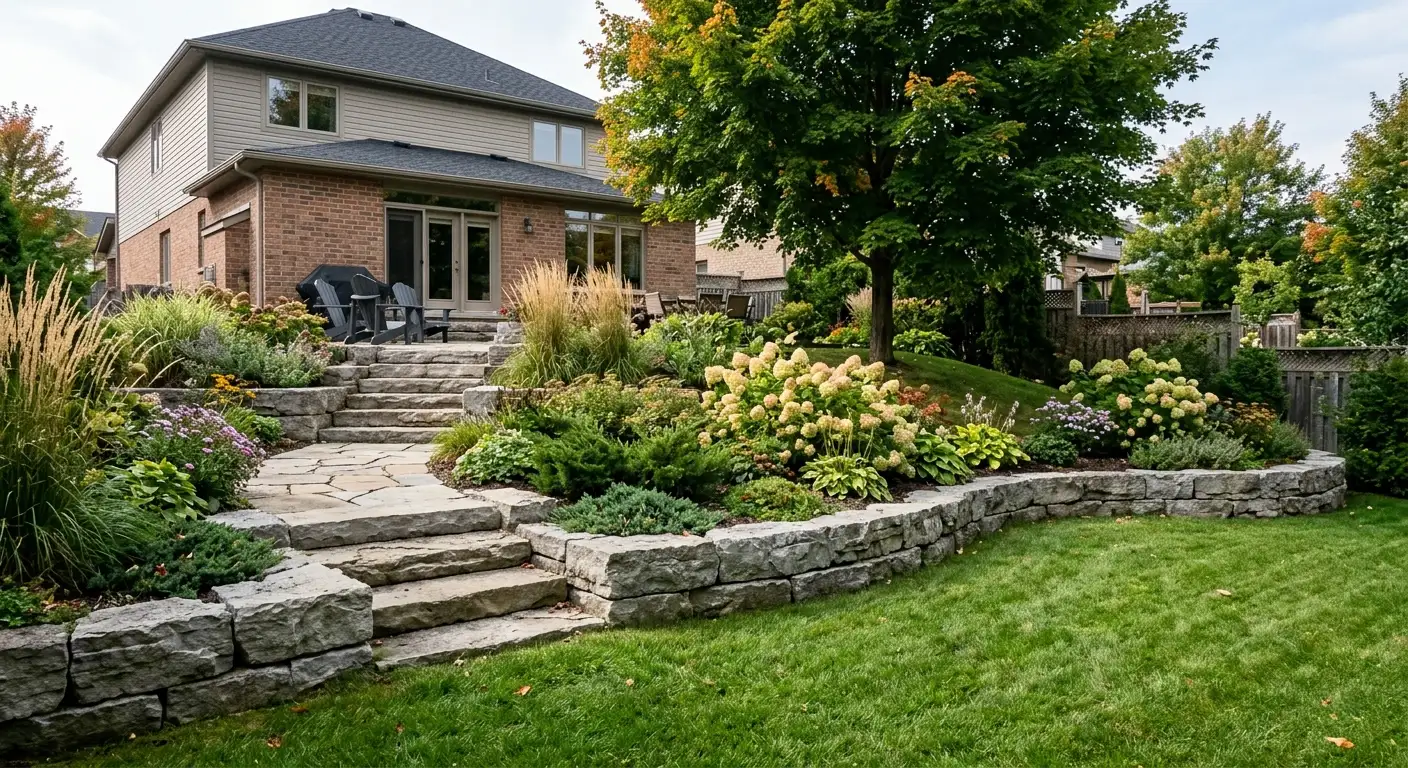
A well-designed slope becomes terraced, usable space. Retaining structures hold grade, create level areas, and turn an awkward incline into planted beds and flat ground. This is where armour stone ottawa features do structural and visual work at the same time, holding soil while anchoring the design. Our guide to armour stone retaining wall planning covers when a property actually needs one.
Steps and Transitions
Grade changes need safe, comfortable ways to move between levels. Stone steps and landings turn a slope people avoid into one they use without thinking.
Where Hardscape and Softscape Meet
The best landscapes balance built elements with planted ones. Too much hardscape feels cold; too little leaves the property without structure.
The built framework, the walkways, walls, patios, and borders, gives the planting something to sit within. Coordinating that framework is where hardscaping ottawa planning matters, because the hard elements define the spaces the soft ones fill. When both are designed together, the result reads as one intentional whole rather than a yard assembled in pieces.
Why Planning the Whole Property Pays Off
Landscapes built in disconnected stages rarely line up. Grades fight each other, materials chosen years apart clash, and later work disturbs earlier work.
The Case for a Master Plan
- Drainage works as one system across the whole property
- Excavation and access are arranged once, not repeatedly
- Materials and colours are chosen to work together
- Each phase, if you build in phases, fits the next
Even on a budget, planning the whole property up front and building it in stages beats improvising one project at a time. A tired driveway, for example, undercuts an otherwise finished yard, which is worth weighing into driveway paving ottawa timing if both are on the horizon.
The Bottom Line
Landscape design that lasts in Ottawa starts with the land and the climate, not the catalogue. Work with the slope, plan for the water, choose materials that handle freeze-thaw, and design the built and planted elements together. Do that, and the property looks better every year instead of worse. We design and build across the region, including nepean landscaping projects in the west, kanata landscaping in the growing communities beyond it, and rockland landscape work across the east.
Are you ready to get your project started? Contact us for a free consultation and a design built around your property.
