
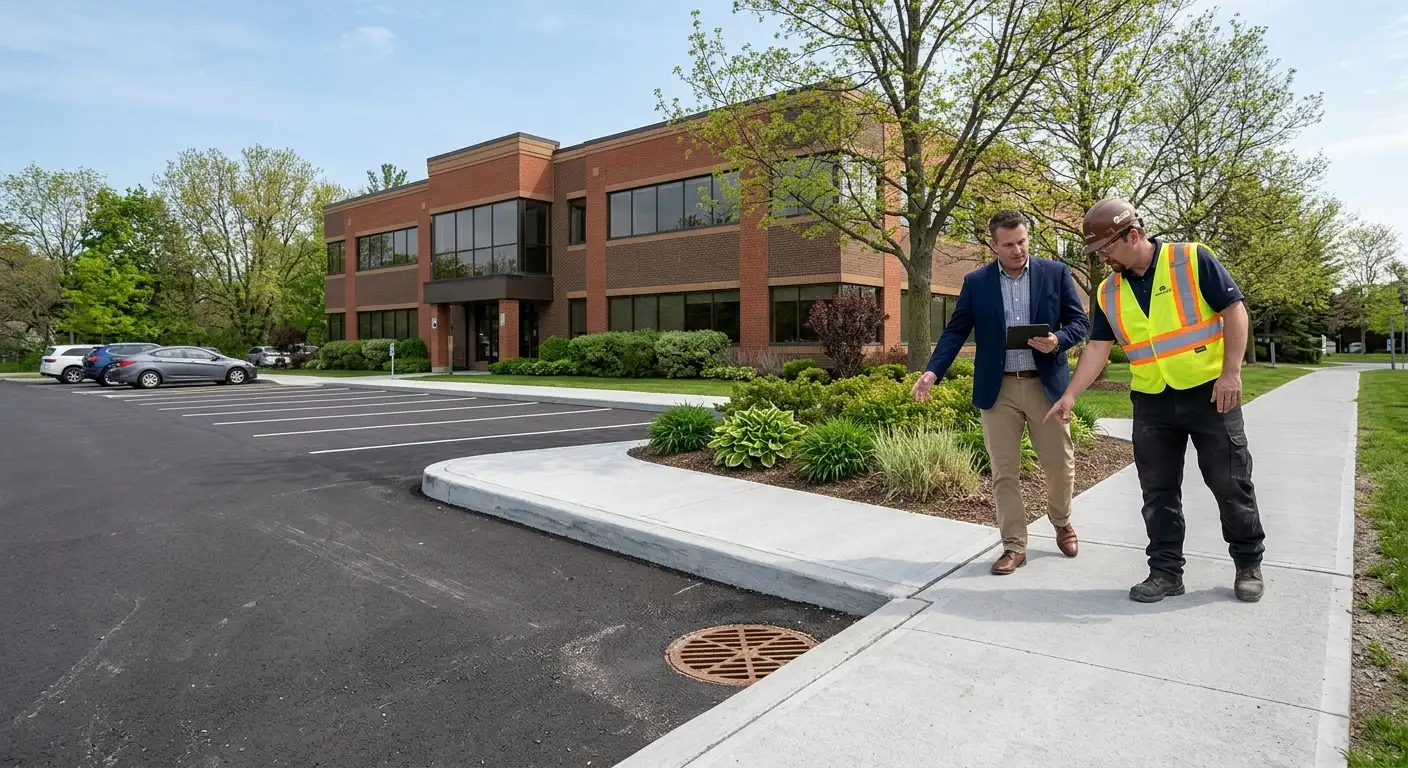
Sidewalks and curbs are the parts of a commercial site nobody notices until they fail. A cracked walkway becomes a trip hazard and a liability. A broken curb stops directing water and lets it undermine the surfaces around it. For property owners and managers, these elements are less about appearance and more about safety, drainage, and code compliance. Here is what actually matters when planning or maintaining them.
Why Curbs and Sidewalks Do More Than They Appear To
It is easy to think of a curb as a raised edge and a sidewalk as a strip of pavement. In practice, both are working parts of a site’s drainage and traffic system.
What Curbs Actually Do
- Direct water toward the drains and collection points you want it going to
- Protect landscaped areas and pedestrian zones from vehicles
- Define traffic flow and parking layout
- Protect the edges of the asphalt, which are always the first part to fail
What Sidewalks Actually Do
- Provide safe, accessible pedestrian routes separated from vehicles
- Carry accessibility obligations that carry real legal weight
- Tie into curbs, entrances, and parking areas as one connected system
When either is done poorly, the whole site suffers. Water pools where it should drain, edges crumble early, and pedestrian areas become hazards.
The Accessibility Dimension
Commercial and municipal walkways are held to accessibility standards, and these are not optional. Slope, width, surface consistency, and transitions all matter, and getting them wrong exposes an owner to both liability and remediation cost.
This is one reason commercial sidewalk construction should be planned rather than improvised. A walkway that meets local standards for accessibility, durability, and appearance protects the people using it and the owner responsible for it.
Drainage Is the Common Thread
Almost every premature failure in curbs and sidewalks traces back to water. Standing water freezes, expands, and works its way into every joint and edge it can find. Over a single winter, that cycle can turn a hairline crack into a structural problem.
Curbs are central to controlling this. Properly placed and graded, asphalt curbs channel water to where the site is designed to handle it. When curbs are missing, damaged, or poorly installed, water goes wherever it wants, and the parking surfaces pay the price. This is the same drainage discipline that governs any commercial asphalt paving project, because the surface and its edges succeed or fail together.
How Concrete and Asphalt Elements Work Together
Commercial sites usually mix materials. Curbs and sidewalks are often concrete, while the driving and parking surfaces are asphalt. These are installed to different tolerances and on different schedules, and coordinating them is where projects go smoothly or go wrong.
Carlsbad manages and coordinates concrete paving services for commercial and municipal clients, working with qualified partners while overseeing scheduling and site readiness. The point of that oversight is to prevent the sequencing errors between concrete and asphalt work that create rework and early joint failure. It is the same coordination logic covered in our guide to commercial concrete management on a busy site.
How This Fits the Whole Site
Curbs and sidewalks rarely stand alone. They connect to parking, entrances, and access routes, and planning them together with the surrounding surfaces avoids doing the same ground twice. On sites with larger driving surfaces, that means coordinating with the commercial parking lot paving schedule so pedestrian and vehicle areas are built as one system.
Planning Curb and Sidewalk Work
Assess Before You Scope
Establish whether the problem is surface-level (cosmetic cracking, worn finish) or structural (failed base, ongoing settlement). The two lead to very different budgets, and the same diagnostic logic applies here as in choosing a driveway contractor ottawa for repair versus replacement.
Coordinate With Surrounding Work
If parking surfaces are also due for attention, doing curbs and sidewalks at the same time avoids disturbing finished work later and usually costs less overall.
Plan Around Access
Pedestrian routes and entrances often cannot all close at once. Phasing keeps the site usable while work proceeds.
The Bottom Line
Curbs and sidewalks are small parts of a commercial site with outsized consequences. They govern drainage, protect your paved surfaces, and carry real accessibility and liability weight. Treating them as an afterthought is how sites end up with pooling water, crumbling edges, and hazardous walkways. Planned and coordinated properly, they quietly do their job for years. We serve commercial and municipal clients across the region, from rockland paving projects in the east to cumberland paving and the surrounding countryside. Are you ready to get your project started? Contact us for a free site assessment and a clear scope.
