
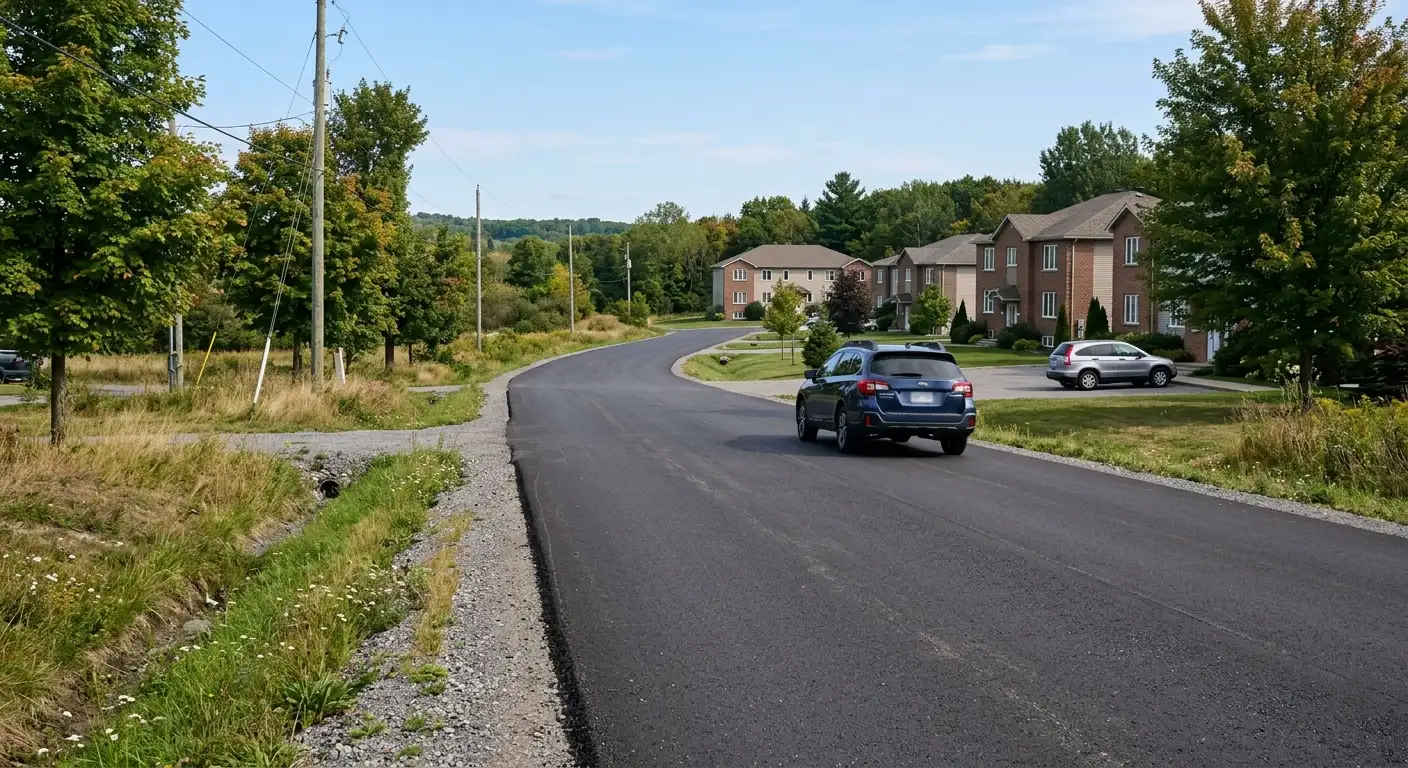
A private road is not just a long driveway. It carries more traffic, often heavier vehicles, and it has to survive rural conditions that a suburban driveway never faces. The same is true of multi-residential drive aisles and access lanes, which take constant turning, stopping, and load that ordinary surfaces are not built for. Getting these right means building for the actual demands, not scaling up a driveway. Here is what that involves.
Why Access Routes Are a Different Job
The instinct is to treat a private road like a bigger driveway. That instinct produces surfaces that fail early, because the demands are genuinely different.
More Traffic, Heavier Loads
Private roads and drive aisles carry far more passes than a residential driveway, and often much heavier vehicles: delivery trucks, farm equipment, waste collection, emergency access. Each of those concentrates load in ways a light-duty surface cannot handle.
Longer Runs, More Variable Ground
A long access lane crosses more soil variation, more drainage challenges, and more grade change than a short driveway. The base requirements can shift along the length of the same road.
Turning and Stopping Points
Drive aisles and access points take repeated turning and braking, which stresses the surface far more than straight-through travel. These points fail first when a surface is underbuilt.
This is why access routes belong in the same category as commercial asphalt paving rather than residential driveway work, even on a private rural property.
The Base Carries Everything
On a surface taking real traffic and load, the base is not just important, it is the entire structural system. The asphalt on top is a wearing surface. What holds vehicles up is underneath.
What Proper Base Construction Involves
- Excavation to a depth matched to the expected loading
- Removal of soft, organic, or unstable material along the whole run
- Granular base placed and compacted in layers
- Adjustment where soil conditions change along the length
- Grading that moves water off and away continuously
Underbuild the base and the surface fails at the heaviest-loaded points first: entrances, turns, and stopping areas. The principle is universal, and it is the same one behind why driveway paving ottawa results depend on what sits beneath the surface, just under far greater demand.
Drainage Over Distance
A short driveway has a simple drainage problem. A long access lane has a complex one, because water has more surface to collect on and more distance to travel.
Standing water is the fastest way to destroy a road surface. Over a long run, grading has to move water off continuously rather than letting it pool anywhere along the way. Culverts, ditching, and proper cross-slope all become part of the design on rural routes. Get the water wrong and even a well-built surface will not last. Curbs often play a role here too, and coordinated asphalt curbs help channel water off longer runs where ditching alone is not enough.
Rural Conditions Add Their Own Demands
Rural properties bring challenges suburban sites do not.
Variable Soil
Country lots often cross clay, sand, and organic soil within a single property. The base has to respond to each rather than assuming one condition throughout.
Access for Construction
Getting equipment and material to a long rural run is itself part of the planning, and it affects both scheduling and cost.
Estate and Agricultural Use
A farm lane taking equipment and a residential estate approach have different requirements again. The surface should match the real use.
We work throughout rural Ottawa and understand these conditions from long experience, including carp paving and west-end estate properties where open lots and variable ground define the work, as well as russell paving across the rural south-east.
Multi-Residential Drive Aisles
The same principles apply to multi-residential properties, where drive aisles, parking, and access routes take constant use.
Here the priorities are durability under repeated turning traffic, drainage that keeps the whole site usable, and coordination with the parking and pedestrian areas around them. The surface is part of a system, and it is planned the way any commercial paving ottawa project is, alongside the commercial parking lot paving and walkways it connects to, as one connected whole rather than isolated strips.
The Bottom Line
Private roads and access lanes reward building for their real demands: heavier traffic, longer runs, variable rural ground, and drainage that works over distance. Treated as an oversized driveway, they fail early at the points that take the most load. Built properly from the base up, they carry years of hard use without complaint. We serve rural and multi-residential properties across the region, including cumberland paving and the eastern countryside.
Are you ready to get your project started? Contact us for a free assessment of your road or access route.
